You’re Not Looking for a Daycare. You’re Looking for a Village.
You typed “daycare near me” into your phone at 9:47pm.
The show was paused, the kitchen was mostly clean, and you told yourself you’d just do a quick search before bed.
That was forty minutes ago.
Now you’ve got six tabs open, a Google Maps view of your neighborhood, and somehow you’re reading reviews from 2019 trying to figure out if the staffing issues mentioned in a one-star review got resolved.
Here’s the thing — this was never really about finding something nearby. The proximity part is easy. What you’re actually trying to figure out, the thing underneath all the clicking, is whether you can trust someone else with your child. And no filter on Yelp sorts for that.

You’re Not Overthinking It
Parents start this search expecting a logistics exercise and end up in an existential spiral, and honestly, that makes complete sense. Because what you’re looking for isn’t just a location that’s licensed and has parking. You’re looking for a place where your kid is genuinely known.
Not managed. Not supervised. Known — the way someone knows that your daughter needs a minute after drop-off before she’s ready to engage, or that your son will happily try new things as long as he doesn’t feel watched while he’s doing it.
That’s not a small ask.
It’s actually the whole ask.
Everything else (the curriculum, the outdoor space, the snack policy) is secondary to whether the people in that building see your child as an individual and not just a number on their enrollment roster.

What Actually Shapes a Child in These Years
In the 1970s, psychologist Mary Ainsworth ran a study that quietly changed how we understand early childhood. She watched how toddlers behaved when left briefly in an unfamiliar room, with and without a trusted caregiver nearby. The results were striking.
Children with a warm, responsive caregiver did something unexpected: they wandered off. They explored. They took small risks and poked at unfamiliar things. When something startled them, they’d come back for a quick check-in and then head right back out into the world. Children without that secure relationship either clung and couldn’t separate, or went flat — disengaged entirely.
Ainsworth called this the “secure base effect.” And it’s been replicated enough times now that it’s less a theory than a fact: a child’s capacity to explore, learn, and develop confidence is directly tied to whether they feel genuinely safe with the adults around them.
This is the part that gets lost in daycare marketing.
The photos of sensory bins and outdoor gardens are lovely, but the research is pretty clear that the single most important variable in your child’s experience is whether their caregivers are warm, consistent, and actually paying attention.
A caregiver who is tuned into your child isn’t an added bonus on top of a good program. They’re what makes a program great.

What a Spilled Cup Can Tell You
One of the small things worth watching when you tour a classroom: what happens when something goes wrong.
In a lot of “daycare near me” settings, an adult swoops in to fix it: mop up the spill, redirect the conflict, smooth over the frustration.
It’s efficient. It keeps things moving.
It also quietly teaches children that problems are for adults to solve and that making mistakes is something to avoid rather than recover from.
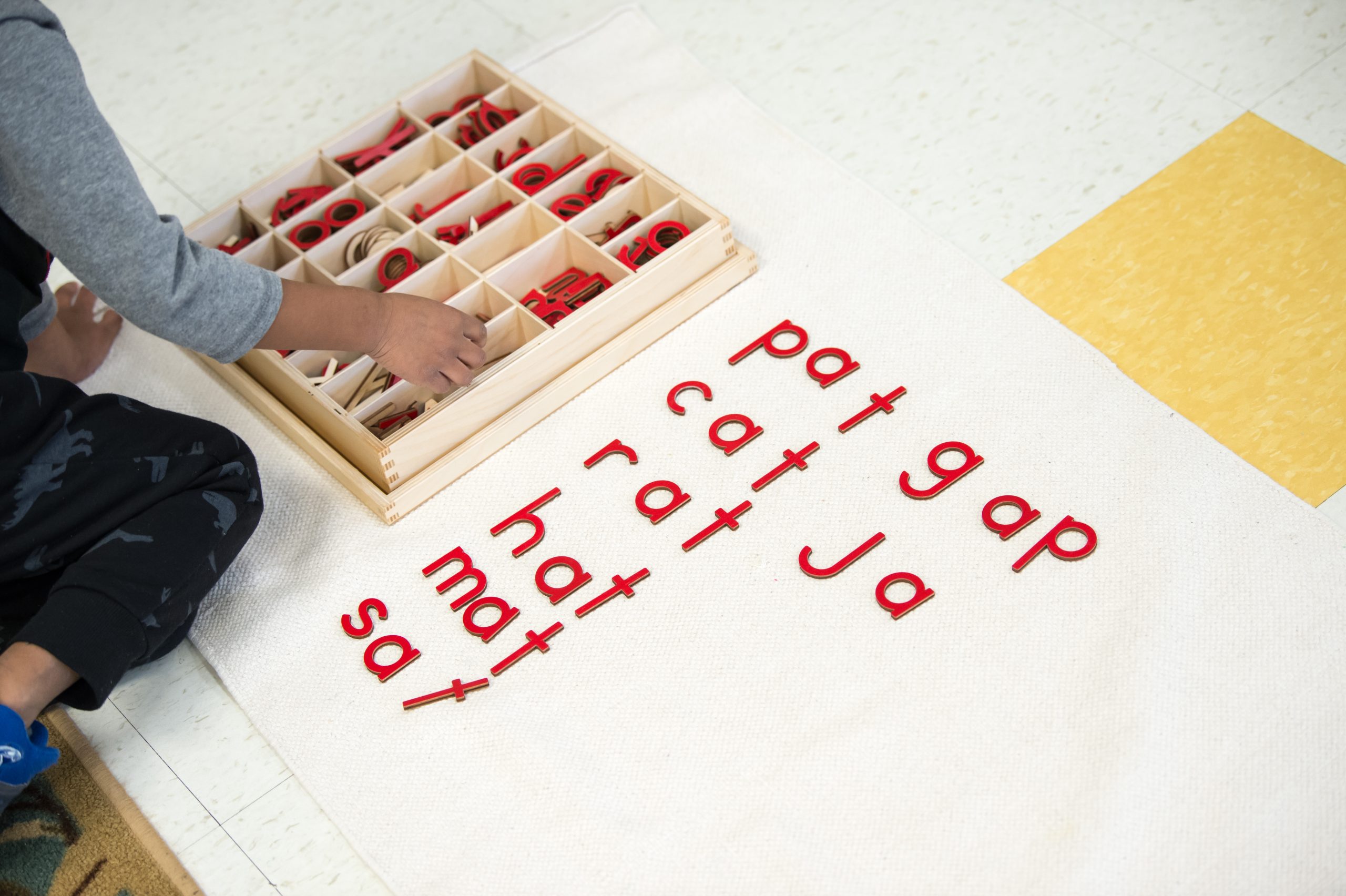
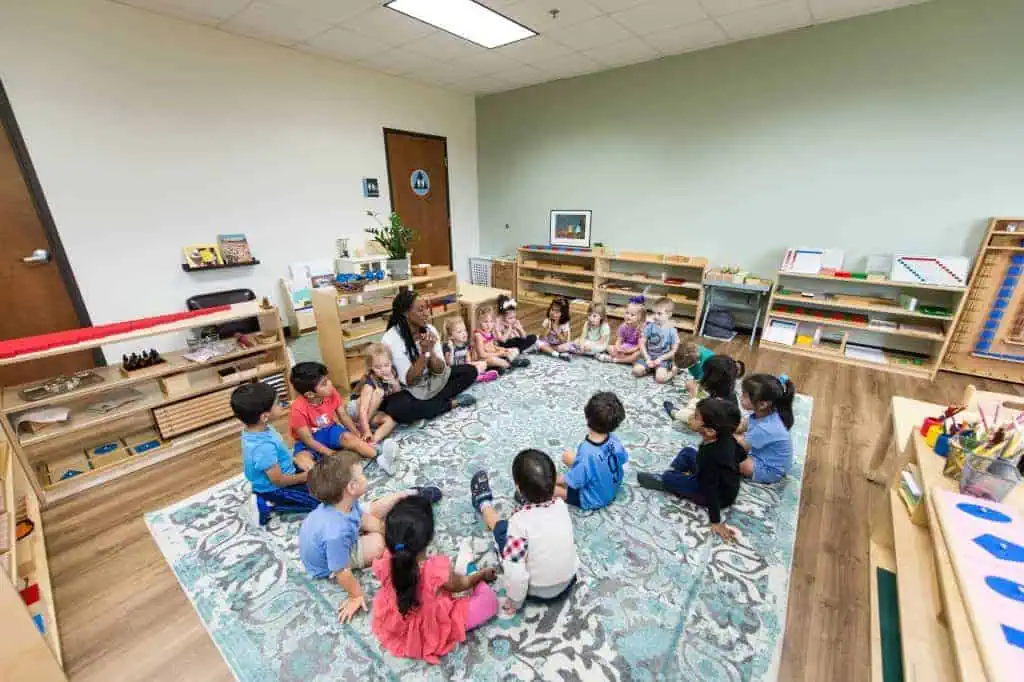
In a Montessori environment, the response looks different. A child spills water and goes to get a towel. Not because someone told them to in that moment, but because that’s just what you do, and they’ve done it before.
A four-year-old works on the same task for twenty minutes without being redirected to something else. A five-year-old kneels down to help a younger classmate with a stuck zipper, completely unprompted.
These aren’t staged moments. They’re what happens when children are given enough time, enough trust, and enough room to figure things out.
A 2006 study in the journal Science found that children in Montessori classrooms showed meaningfully better outcomes across executive function, literacy, math, and social development, including more positive peer interactions and stronger fairness reasoning. Across income levels, not just in well-resourced settings.
The classrooms that produce those outcomes tend to feel, when you visit them, less like school and more like a place where kids are genuinely busy with something that matters to them.
That’s worth paying attention to.


If Your Child Is Already Enrolled
A lot of parents reading this aren’t searching at all. Their child is already enrolled somewhere, probably at a “daycare near me”, and something made them look up this article. Maybe a drop-off that felt off. Maybe a comment your kid made at dinner that you’ve been turning over in your head.
Trust that.
Good programs welcome those conversations. They don’t get defensive when you ask specific questions, and they don’t answer “how was her day” with “great!” every single time. The teachers can tell you what your daughter worked on, what made her laugh, what she found hard. The director responds to your email the same week (ideally the same day) you send it.
Programs like Guidepost Montessori’s are designed around that kind of ongoing partnership with families: regular communication, real transparency, and the understanding that you are not an inconvenience for wanting to know what’s actually happening in your child’s day.
That standard should be the baseline, not the exception.
If what you’re getting feels more like reassurance than information, it’s okay to push for more.
You’re not being difficult. You’re being a parent.

What to Look For on a Tour
When you’re working through your “daycare near me” search and actually visiting places, here’s what tends to matter more than the things on the checklist.
Watch how the staff talk to children when they don’t think anyone is watching. Notice whether children seem self-directed or whether they’re just waiting to be told what to do.
Ask — specifically — what a teacher does when a child is having a hard day. Not a crisis, just a hard day. The answer will tell you a lot about the culture of the place.
A few other questions worth asking:
- Do children have long, uninterrupted stretches to work and explore, or is the day broken into short directed segments?
- When a child struggles with something, are they encouraged to keep at it, or moved along?
- Do older kids genuinely mentor younger ones, or is the age mixing more incidental?
- How does the school communicate with families when something isn’t going well?
And when you walk in (before you’ve asked a single question) notice how you feel.
Whether the room feels like a place where children are respected or a place where they are simply contained. You have years of data on your child and a functioning nervous system. Both of those things are useful here.


What You’re Really Looking For
The honest version of “daycare near me” is: Who will love my child while I’m not there?
That’s a vulnerable thing to need. Most of us were raised in places where that answer was grandparents, neighbors, the family down the street who just always had kids running through their kitchen.
That network is harder to find now.
Most of us live farther from family, we know our neighbors less, we piece together something resembling a village and hope it holds.
What you’re searching for at 9:47pm is a real piece of that. Not a facility. Not a program. People who understand the weight of what you’re handing them when you drop your child off and drive away.
You might not find perfect. But you can find people who take that seriously. That’s what the search is actually for.
Keep the tab open until you find it.
And if your search brings you to Guidepost Montessori — we’d love to show you what that looks like in person.